2026 Utah Once‑in‑a‑Lifetime Tags — Should You Apply for Moose, Sheep, Goat, and Bison?
If you're already in the Utah system for elk, deer, or antelope, you've probably looked at the once‑in‑a‑lifetime species and wondered if you should add a few more boxes before you hit submit. You've already paid for the license. At that point, moose, sheep, goat, and bison are a $21 lottery ticket for the kind of hunts people pay six figures for at the Western Hunt Expo. That math is hard to ignore.
This is the fourth and final episode in our 2026 Utah Application Series. We covered elk, mule deer, and antelope in the first three episodes — links below. This one is all about the once‑in‑a‑lifetime species and whether they belong in your strategy.
What "Once‑in‑a‑Lifetime" Actually Means
Utah uses this term literally. If you draw and fill one of these tags, you cannot apply for that species again. Ever. The five species on the list are Rocky Mountain bighorn sheep, desert bighorn sheep, Rocky Mountain goat, Shiras moose, and bison.
Every nonresident needs a valid Utah hunting license to apply — same as any other species in the state. That license is your entry point, and if you're already buying it for elk or deer, you're already in. The once‑in‑a‑lifetime application fee runs about $21 per species. That's the cheap part.
If you draw, the tag itself is not cheap. In 2025, moose, sheep, and goat tag fees ran $2,244 for nonresidents, and bison came in at $2,420. Those numbers will likely be slightly higher for 2026. That's still a fraction of what these hunts cost on the open market. At the 2026 Western Hunt Expo, Utah conservation permits for these species sold for staggering amounts — statewide Rocky Mountain bighorn hit $290,000, statewide desert bighorn brought $170,000, and the statewide bull moose tag sold for $115,000. When I say lottery ticket, I genuinely mean it.
Why You'll Never "Build to" 100% Odds
When we talk about elk, deer, and antelope in Utah, there's a clear path where consistent point-building eventually gets you to near-certain draw odds somewhere. You might have to compromise on weapon, season, or unit, but you're always moving toward something.
That's not how these once‑in‑a‑lifetime tags work.
Across all five species, there are very few nonresident tags issued each year — combined with massive point pools that have been building for decades. Even at high points, your odds are measured in fractions of a percent. The number of people ahead of you in the pool is so large, and the annual tag numbers so small, that you will never mathematically work through it. These are annual lottery tickets. Your odds get slightly better each year, but 100% odds isn't a destination you're ever reaching if you're starting now.
That's not a reason to skip them — it's just the right frame going in.
Species Breakdown
Rocky Mountain Bighorn Sheep
There were only five nonresident permits available in 2025, and draw odds sit around 0.01% for most applicants. That said, if you do draw, Utah manages these units for 100% success rates. Most units are consistently hitting that number, and some are producing Rocky Mountain bighorns in the 175-inch class, which is a legitimate giant. The units that generate the most buzz are part of the actual Rocky Mountain range — the real deal.
One unit, the Nine Mile Gray Canyon, does have a guaranteed draw at 29 points for nonresidents, but the rest are randomly allocated with no point-based guarantee in sight. If a Rocky Mountain sheep hunt is on your bucket list, $21 a year is a reasonable price to stay in the pool.
Desert Bighorn Sheep
Desert bighorn draws are slightly more accessible — nine nonresident permits in 2025 compared to five for Rocky Mountain. Odds roughly double as a result, putting nonresidents somewhere in the 0.05–0.1% range depending on the unit. Success rates are strong across the board, with most units hitting 50–100% and trophy potential running 150–170 inches. If you're a desert sheep person, the same logic applies. If you're not passionate about it, it's easy to skip.
Mountain Goat
I'll be honest — mountain goat isn't something I personally want to do. But for some hunters, especially those who want a goat hunt without the extreme ruggedness of Alaska or the Northwest Territories, Utah actually makes a compelling case. Several units offer relatively easy access compared to what you'd expect, which could matter if the physical demands of a high alpine goat hunt feel out of reach.
The downside is that goat populations in Utah have been declining. Permits have pulled back, and some units no longer offer nonresident tags at all. Nine permits were available for nonresidents in 2025. Odds are marginally better than sheep simply because demand is lower, but you're still talking about something like 0.02%. If you're passionate about a goat hunt, it's worth $21. If you're lukewarm, it's easy to pass.
Shiras Moose
This is the one I get most excited about. There were only 10 nonresident permits in 2025, but success rates are exceptional — most units are near 100%, with the lowest sitting around 50%. Trophy quality is on par with Colorado, with plenty of 40-inch bulls and occasional 50-inch class animals showing up, which is big for a Lower 48 Shiras moose.
The demand is enormous, and the point pool reflects it. Even near max points, nonresidents are still looking at about 0.1% odds. There are roughly 1,500 nonresidents at just one point ahead of any brand-new applicant today — at that rate, it would take over 150 years just to work through a single layer of the pool. But if you dream about hunting a bull moose in the lower 48 without booking a guided hunt in Canada or Alaska, $21 a year to keep your name in the draw is hard to argue with.
Bison
Utah is one of the only places in the world where you can hunt truly free-ranging wild bison on public land. The Henry Mountains and Book Cliffs units are exactly what they look like on YouTube — big public land, long seasons, and real opportunity to harvest if you're drawn. There were 12 nonresident limited-entry permits available in 2025, and odds — while still small — are slightly better than moose, ranging from 0.02% up to around a quarter of a percent near max points.
One important caveat: Utah also offers an over-the-counter bison hunt in the Nine Mile unit, and it is not what it sounds like. That hunt was created to reduce bison drifting off reservation land, and success rates have dropped sharply since the first year. More critically, buying an OTC Nine Mile permit permanently forfeits your ability to ever apply for limited-entry bison in the Henry Mountains or Book Cliffs draw. If you don't know the herd movements, have scouting time, and understand what you're walking into, avoid the OTC option and stay in the limited-entry draw.
Dive Into the Numbers
Every number I just walked through — draw odds, success rates, trophy potential — came straight out of GoHunt Filtering 2.0. If you want to dig deeper on any of these species or cross-reference them against your current point totals, that's where I'd start.
Should You Apply?
If you're already paying for the Utah license, the question isn't really whether you can afford these lottery tickets — it's which ones actually matter to you.
I apply for Rocky Mountain bighorn, moose, and bison every year. I skip mountain goat because it's not on my list, and I skip desert bighorn because it doesn't pull at me the same way. That's three species at $21 each — a $63 add-on to an application I'm already doing. Considering the upside, I'll take that bet every year.
What I wouldn't do is buy a Utah hunting license specifically to apply for once‑in‑a‑lifetime tags. The license cost makes that math not work unless you're also building points for elk, deer, or antelope. But if Utah is already in your rotation, adding the species you care about is one of the cheapest smart moves in western hunting.
One last thing: always apply for an actual permit, not a point-only option. Utah's hybrid draw means there is always a random chance to draw no matter how many points you have. Don't leave that chance on the table.
The 2026 application deadline is April 23rd at 11 p.m. Mountain Time. Don't miss it.
Never Miss a Deadline
Sign up for the Drawn West newsletter and get every state guide and bonus series episode sent straight to your inbox.
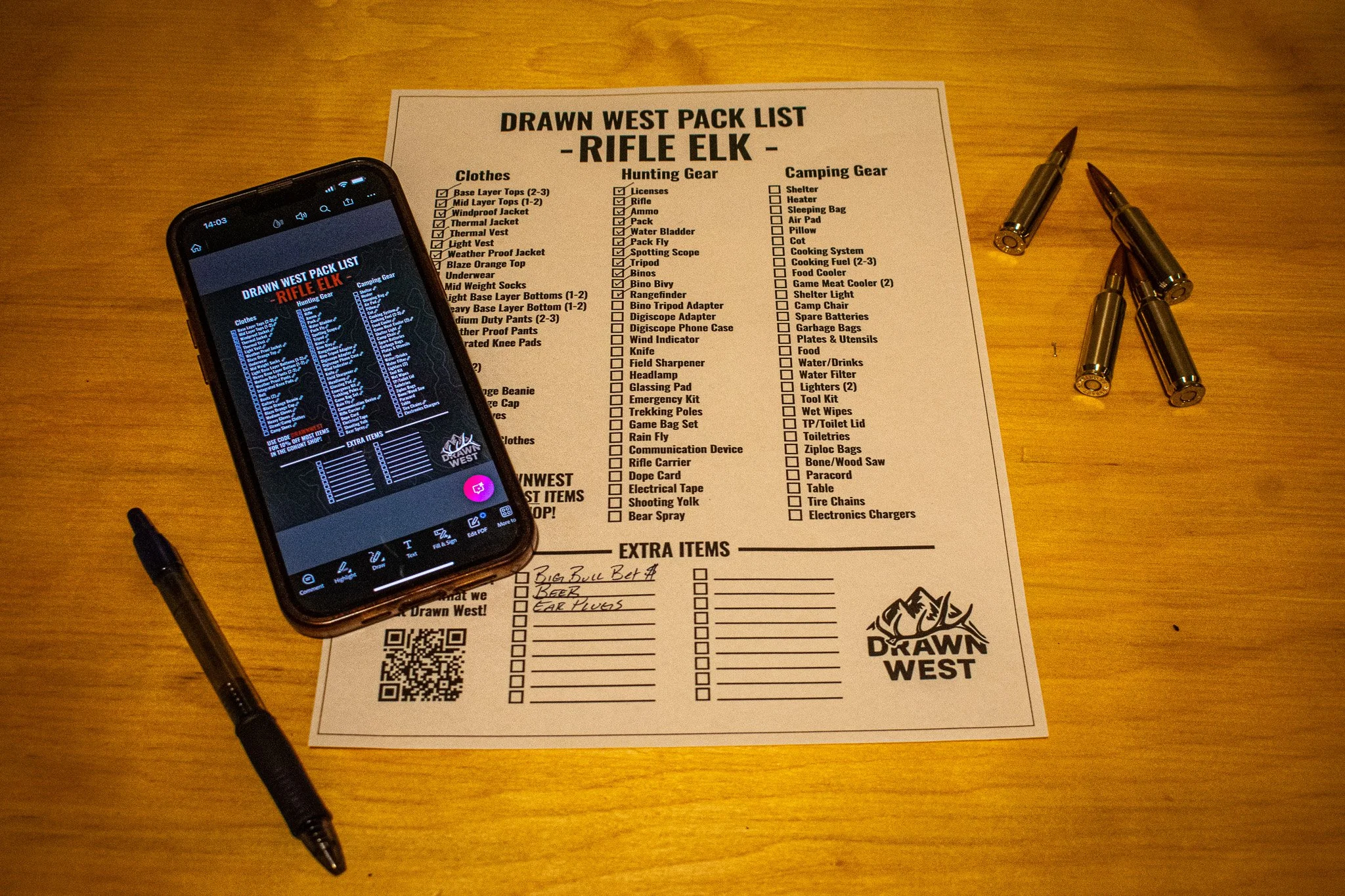
It’s hard to know what calls are worth putting in your pack, especially on your first hunt. Here's what's in my pack, why I run a diaphragm 3-pack as the foundation, and when to reach for backup options like the Hoochie Mama or EZ Estrus.